If you’ve ever got a chance to buy plumbing fittings at any hardware store nearby, you’ve probably seen some abbreviations like MIP, FIP, NPT, and MPT. These short terms can be confusing, especially for DIY homeowners like us.
So, what does MIP mean in plumbing?🤔🤔🤔
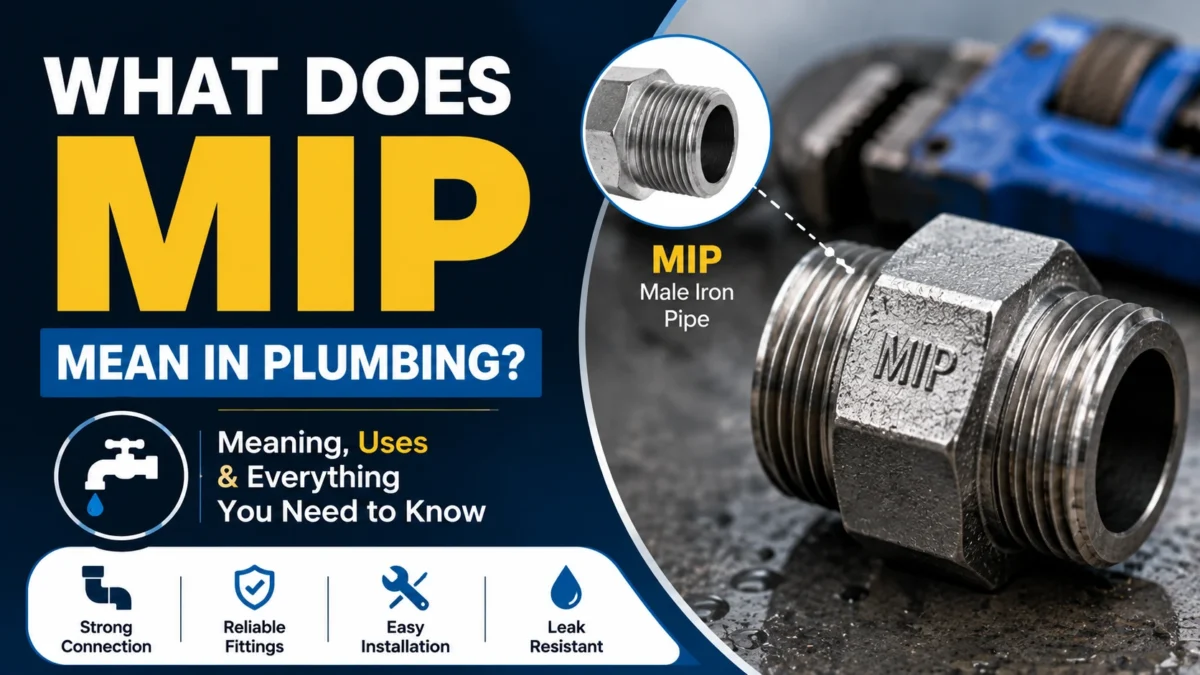
ITs quite simple! MIP stands for Male Iron Pipe. It refers to a plumbing fitting with male (external) threads that screw into a fitting with female (internal) threads. Despite the name, MIP fittings are not always made from iron only, they can be made with brass, stainless steel, copper, PVC, or other materials too.
In this guide, I will share everything about MIP fittings, how they work, where they’re used, and more..
What Does MIP Mean in Plumbing?
MIP (Male Iron Pipe) is a threaded plumbing connection with threads on the outside of the fitting.
Just think of it like a bolt screwing into a nut.
- MIP = Male Threads
- FIP = Female Threads
The male threads screw into female threads to create a secure plumbing connection.
For example:
- Water heater connectors
- Shower arms
- Pipe nipples
- Brass adapters
- Outdoor hose connections
Did you know? – MIP fittings are among the most common threaded plumbing connections in residential and commercial plumbing systems.
But Why Is It Called “Iron Pipe”?
Many people assume MIP fittings are only used with iron pipes as the name suggest!
That’s actually a very common misconception.
The term originated decades ago when plumbing systems were primarily made from galvanized iron pipe only.
Today, MIP threads are commonly found on:
- Brass fittings
- PVC adapters
- CPVC fittings
- Stainless steel fittings
- Black steel pipe
- Copper transition fittings
The thread standard has remained the same even though the materials have changed.
How Does a MIP Connection Work?
A MIP fitting has external threads that tighten into a female threaded fitting.
Here is the Example connection:
Male Iron Pipe (MIP)
↓
Screws into
Female Iron Pipe (FIP)
When tightened correctly using:
- PTFE (Teflon) tape
- Pipe thread sealant (pipe dope)
the connection becomes watertight.
Most Common Uses of MIP Fittings
MIP fittings are used in nearly every type of plumbing system.
Examples include:
Water Heaters – Flexible supply lines often connect using 3/4-inch MIP threads.
Shower Arms – Most shower arms have a 1/2-inch MIP thread on each end.
Outdoor Faucets – Hose bibs frequently use MIP threaded connections.
Gas Lines – Black steel gas pipes commonly use MIP threads.
Pipe Adapters – PVC-to-metal adapters often feature one end with MIP threads.
Common MIP Fittings
You’ll frequently encounter the following MIP fittings:
- MIP Adapter
- MIP Coupling
- MIP Elbow
- MIP Tee
- MIP Nipple
- MIP Union
- MIP Cap
- MIP Plug
Each serves a different purpose depending on the plumbing layout.
MIP vs FIP
| Feature | MIP | FIP |
| Full Form | Male Iron Pipe | Female Iron Pipe |
| Threads | Outside | Inside |
| Connection | Screws into FIP | Receives MIP |
| Common Use | Pipe ends | Valves, fittings, adapters |
| Requires | Female fitting | Male fitting |
These two fittings are designed to work together.
MIP vs NPT
This is one of the most frequently asked questions.
The answer is:
Most MIP threads use the same thread standard as NPT (National Pipe Thread).
In most residential plumbing applications:
- MIP ≈ Male NPT
- FIP ≈ Female NPT
Many manufacturers use these terms interchangeably.
MIP vs MPT
Another common abbreviation is MPT.
MPT stands for:
Male Pipe Thread
In most plumbing situations:
- MIP
- MPT
- MNPT
all refer to the same style of male threaded connection.
Always verify the manufacturer’s specifications for compatibility.
Materials Available in MIP Fittings
MIP fittings come in many materials depending on the application.
| Material | Best For |
| Brass | Water supply |
| PVC | Irrigation and drainage |
| CPVC | Hot and cold water |
| Stainless Steel | Corrosion resistance |
| Black Steel | Gas lines |
| Galvanized Steel | Outdoor plumbing |
Choose the material that matches your plumbing system and local building codes.
How to Install a MIP Fitting
Installing a MIP fitting is straightforward if done correctly.
- Step 1 -Clean both threaded surfaces.
- Step 2 – Wrap PTFE (Teflon) tape clockwise around the male threads 3–5 times.
- Step 3 – Alternatively, apply a suitable pipe thread sealant.
- Step 4 – Hand-tighten the fitting into the female fitting.
- Step 5 – Use a wrench to tighten further, avoiding over-tightening, which can damage the threads.
- Step 6 – Turn on the water and inspect the joint for leaks.
Understanding what MIP means in plumbing makes it much easier to choose the right fittings for your home plumbing. MIP stands for Male Iron Pipe, describing a fitting with external threads that connects to a female-threaded fitting.
Also Read:
Plumbing Marketing Ideas: 20 Proven Strategies to Grow Your Plumbing Business