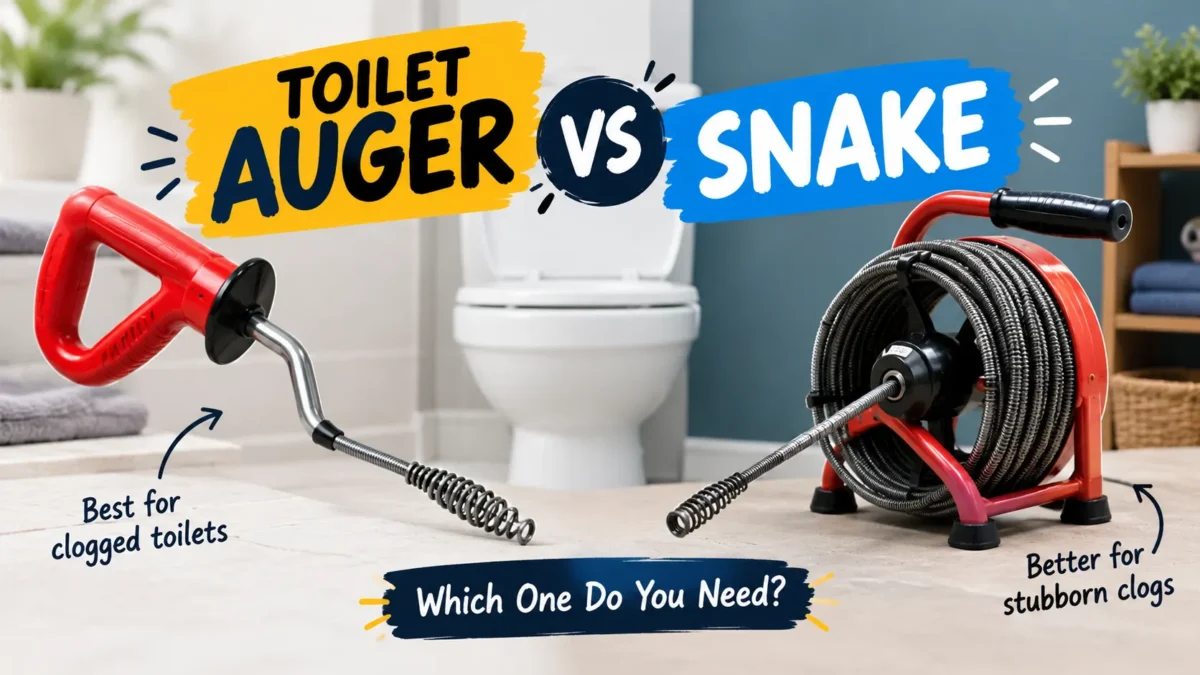
Hello guys, welcome back to my blog. Today I am going to talk about toilet auger vs snake. Both tools look almost same and both are used for clogs, so a lot of people get confused about which one to buy.
If you ask me, the answer is very simple. A toilet auger is made for the toilet and a drain snake is made for the pipes after it. In this blog I will tell you what each tool do, which one you should buy and when you should just call a plumber.
I also went through a lot of Reddit threads where plumbers and home owners shared their real experience. So I will share that with you too, along with some YouTube videos that helped me.
Toilet Auger vs Snake: The Quick Answer
If you are in hurry, here is the short answer. Use a toilet auger when the clog is inside the toilet. Use a drain snake when the clog is in a sink, tub or further down the drain line.
The experts in Family Handyman’s toilet auger vs snake guide also say a toilet auger is the best tool for most toilet clogs. This drain cleaning tool guide from Cleaner magazine says the same thing. It puts the closet auger on toilets and a small hand snake with a 1/4 or 5/16 inch cable on sink and laundry drains.
| Where is the clog? | Tool I will use |
|---|---|
| Inside the toilet bowl or its trap | Toilet auger (also called closet auger) |
| Sink, tub or shower drain | Drain snake (hand snake) |
| Main sewer line or many drains backing up | Call a plumber |
Honestly, I think this one simple rule will save you from a lot of trouble and a lot of mess.
What Is a Toilet Auger?
A toilet auger is a short hand tool made only for toilets. Plumbers also call it a closet auger, because the old name for a toilet is water closet. It has a crank handle on top, a metal tube in the middle and a coiled cable inside the tube.
The tube has a curve at the bottom end. CPI Plumbing’s guide on plumbing snakes and closet augers says this rigid shaft with a special bend helps the auger go through the toilet’s S-bend without scratching the porcelain. That bend is covered with a rubber or vinyl sleeve, so the metal does not touch the bowl.
Every toilet has a curvy pipe built inside it called a trap. As per Wikipedia’s article on the plumbing trap, this U-shaped pipe holds some water all the time, and that water stops sewer gas from coming into your house. This trap is also where most toilet clogs get stuck, and the toilet auger is made exactly for this part.
Most toilet augers come in 3 feet or 6 feet length. For example, the RIDGID K-6P toilet auger has a quick lock that lets the cable go out to 3 feet for the bowl and then to 6 feet to clear just beyond it.
If you ask me, I really like how simple this tool is. No motor, no battery, just a handle you turn with your hand.
What Is a Drain Snake?
A drain snake is a long and thin metal cable that you push down a drain and turn with a crank. People also call it a plumber’s snake, hand auger or drain auger. Wikipedia’s article on the plumber’s snake says hand augers are useful for sink and bathtub drains, but they are not suitable for flush toilets.
The cable is quite thin. As per this Dummies guide on how to unclog a drain with a snake, the coiled steel wire is usually about 1/4 inch thick. It sits rolled up inside a drum, so you can feed it far down the pipe.
Pipe size is the main thing here. A plumber told Pro Tool Reviews in their drain auger vs snake article that drain snakes are for small drains from 1-1/4 to 2 inch, like kitchen and bathroom sinks. Bigger lines need a stouter tool.
A drain snake is also much longer then a toilet auger. In Bob Vila’s tested list of the best drain snakes, several picks have a 25 feet cable and their best manual one has 15 feet. Compare that with the 3 or 6 feet of a toilet auger and you will get the idea.
I think every home should keep one small drain snake for sink and shower hair clogs. Just keep it far away from your toilet.
Toilet Auger vs Drain Snake: Side by Side Comparison
Here is a simple table I made so you can compare both tools in one look.
| Feature | Toilet auger | Drain snake |
|---|---|---|
| Also called | Closet auger | Plumber’s snake, hand auger |
| Made for | Toilet bowl and its built-in trap | Sinks, tubs, showers and small drain lines |
| Cable length | 3 ft or 6 ft | Usually 15 to 25 ft, some even longer |
| Cable | Thick, stiff and kink resistant | Thin (about 1/4 inch) and very flexible |
| Bowl protection | Vinyl or rubber guard on the bend | None, it is bare metal |
| Safe inside a toilet? | Yes, if you use it gently | No, it can scratch the porcelain |
| Starting price | Basic models under $30 | Around $25 for a sturdy metal one |
If you ask me, the bowl protection row is the most important one in this table. That one small rubber guard is the reason the toilet auger exist.
Why You Should Not Use a Sink Snake in Your Toilet
Honestly, this is the biggest mistake people make. They already have a drain snake for the sink, so they just push it into the toilet. Please don’t do this, guys.
The first problem is scratches. A drain snake is bare metal and it rubs on the bowl when you crank it. In This Old House’s guide on how to snake a toilet, plumbing expert Richard Trethewey says a closet auger is the right next step after the plunger, because a regular hand snake can scratch the porcelain badly.
Reddit has real stories about this. One homeowner on r/Plumbing scratched the toilet enamel with a regular drain auger and learned it the hard way. In the same thread, a plumber told them to use a closet auger instead of that 1/4 inch snake.
The second problem is size. Toilet drains are wide, so a thin cable just bends and tangles inside. Wikipedia even says a 1/4 inch cable should never go in a drain bigger then 2 inches. Another plumber on Reddit made the same point, that most homeowners grab a small hand auger but it won’t work in a big pipe like that.
There is one more thing many people don’t know. Orange Coast Plumbing’s guide on using a toilet auger warns that some toilet makers may void the warranty if you use a plumbing tool like an auger or snake on their toilet. So if your toilet is new, I think it is smart to check the warranty papers first.
Which Toilet Auger Should You Buy?
So you decided to get a toilet auger. Good choice. Now here are the things I would check before buying one.
3 Feet or 6 Feet?
For most homes, a 3 feet auger is enough. A plumber on Reddit explained the 3 ft vs 6 ft toilet auger difference in a very simple way. A 3 feet cable basically gets you through the toilet, and that clears most clogs because they usually happen in the trapway. A 6 feet cable goes further down the pipe, so it helps when something is stuck in the flat section just after the toilet.
| 3 ft toilet auger | 6 ft toilet auger | |
|---|---|---|
| How far it reaches | Through the toilet trap | Through the trap and about 3 ft beyond |
| Good for | Everyday paper and waste clogs | Clogs stuck just past the toilet |
| Examples | RIDGID K-3, General 3 ft Flexicore | RIDGID K-6P, General 6 ft Teletube |
| My pick for | Normal homes | Homes with repeat clogs |
Build Quality Matters
Cheap auger can kink very fast. Plumber Magazine’s article on which tool clears toilet clogs fast says the consumer augers sold in hardware stores often use a hollow snake that kinks easily. Professional ones use a multi-layer inner core cable that resists kinking.
Reddit users say the same thing. One person shared that they kinked and wrapped up both Ridgid and Bauer augers, but their General augers lasted more than 15 years. General is the company behind General Pipe Cleaners Flexicore closet augers, which use two layers of spring wire wrapped around a 49-strand wire rope core. Their 6 feet Teletube model even hides an extra 3 feet of cable inside the tube until you press a button.
Manual or Drill Powered?
Most toilet augers are hand crank, and that is fine for a home. Some models like the RIDGID K-6P can also run with a cordless drill for tough clogs.
If you ask me, a good 3 feet auger is enough for a normal home. But if your toilet clogs again and again, I would spend a little more on a 6 feet pro model.
Try a Flange Plunger First
Before you take out any auger, try a good plunger first. Most normal clogs from waste and too much toilet paper clear with a few strong plunges.
But the type of plunger matters a lot. This Old House’s guide on how to unclog a toilet says to use a flange style or beehive plunger made for toilets. Their expert Richard Trethewey also likes a pulling motion more than just pushing down. The flat cup plunger you use for sink does not seal well in a toilet hole.
On Reddit, one user called the Korky beehive plunger their go-to tool for clearing toilets. The Korky BEEHIVE Max toilet plunger is made to fit both old toilets and new high efficiency toilets, which have more oblong drain holes. Bob Vila’s review of the best toilet plungers also picked the Korky Beehive Max as the best overall.
Here is one small trick I liked from Art of Manliness’s illustrated guide to unclog a toilet like a plumber. Take off the tank lid and press the flapper down, so the bowl stops filling and does not overflow on your floor.
I think a good plunger is your first tool and the toilet auger is your backup. You don’t need to jump to the auger every single time.
How to Use a Toilet Auger Without Scratching Your Toilet
Using a toilet auger is easy, but you have to go slow. These are the steps I put together from the guides I trust the most.
- Wear rubber gloves and put some old towels around the base of the toilet.
- If the bowl is very full, scoop some water into a bucket first so it does not splash out.
- Pull the crank handle up so the cable goes fully back inside the tube.
- Put the curved end into the bowl and point it into the drain hole. The rubber guard should rest on the porcelain.
- Turn the handle clockwise while you gently push down. Stop pushing when the handle gets stiff, because that is the clog.
- Keep cranking to break the clog or hook it. You can push and pull a little, but never force it.
- Keep turning the handle as you slowly pull the cable back up and out.
- Flush to test it, then clean the auger with hot soapy water and let it dry.
iFixit’s step by step guide on how to unclog a toilet with an auger shows these same steps with photos. It also says a $20 toilet auger can save you from a $150 plus plumber visit, which I think is a great deal.
HomeServe’s guide on using a toilet auger gives one more useful tip. Push the curved end in until you can only see the rubber sleeve and tube, and only then start turning. The This Old House experts also say to pull a hooked clog back toward you, because pushing it deeper into the narrow trap can pack it even harder.
Even with the right tool you need to be careful. One Reddit commenter pointed out that an auger can still damage your toilet, and for clogs that keep coming back they suggested spending on a faster option instead of augering again and again. So I always keep the rubber guard tight on the bowl and never fight with the handle.
When Should You Call a Plumber?
A toilet auger is great, but it has limits. It only reaches 3 or 6 feet, so if the clog is far down the line, it just can’t get there.
On r/askaplumber, one plumber’s advice was to get a 6 ft toilet auger, and beyond that call a plumber if you are not experienced. I totally agree with this simple rule.
These are the signs that the problem is bigger than your toilet:
- More than one drain is backing up at the same time.
- Water comes up in your tub or shower when you flush.
- You hear gurgling sounds from other drains.
- Bad smell is coming from many drains.
- You already augered a few times and it still clogs.
Home Depot’s guide on how to use a drain snake explains it very simply. If only one drain is backed up, the clog is between that drain and the main line. If many drains are backed up, the clog is in the main line, and that needs a big drain auger machine.
This Old House’s guide on how to snake a clogged drain also says a small hand snake won’t be effective when the stoppage is down in the main drain. And Mr. Rooter’s homeowner guide to snaking a toilet says that when the plunger, snake and auger all fail, it is time to call the professionals.
Cost is also something to think about. As per Bob Vila’s guide on how to snake a drain, hiring a pro to snake a drain costs around $145 to $300. So I think trying a plunger and a toilet auger first is worth it. But for main line problems, don’t waste your time, just call a plumber.
YouTube Videos Worth Watching
Reading is good, but sometimes watching someone do it is much better. Here are some YouTube videos I found really helpful:
- How to Unclog Any Drain by Ask This Old House shows Richard Trethewey going through almost every drain in a house and how to clear each one. This is the best video to understand toilet auger vs snake in one go.
- How to use a toilet auger with Ace Hardware’s Lou Manfredini is a short and clear demo for beginners.
- How to use the RIDGID K-6P toilet auger is RIDGID’s own video on their 6 feet auger, good if you are thinking to buy one.
- How to use the RIDGID K-6P XL toilet auger with interchangeable heads shows the bigger kit and when to use each head.
- How to unclog a toilet with a toilet auger with Graham from Urban Piping shows a plumber clearing a real clogged toilet.
- Toilet auger tips from Howie at Quality First Plumbing & Heating has some simple tips on using it the right way.
If you ask me, watch the Ask This Old House one first and then any one toilet auger video. That is enough to learn it.
FAQs About Toilet Auger vs Snake
Can I use a drain snake on a toilet?
I would not. A drain snake is bare metal, so it can scratch the porcelain, and the thin cable can tangle in the wide toilet drain. HomeServe UK’s guide on how to use a drain snake also says to always use a toilet auger on a toilet, not a standard drain snake.
Is a toilet auger the same as a toilet snake?
People use these names very loosely. Mr. Rooter’s guide on how to use a drain snake calls the toilet auger, or closet auger, a drain snake made just for toilets. Even the plumbers in the Family Handyman article mostly say “snake” for everything.
Can a toilet auger crack my toilet?
It can if you force it. Family Handyman warns that pushing a stiff auger too far can put enough pressure on the porcelain to crack it. If you need to go deeper than a foot or two, switch to a longer and more flexible tool or call a pro.
Can I rent a toilet auger instead of buying one?
Yes, you can. Home Depot’s guide on how to unclog a toilet mentions you can rent augers from their Tool Rental Center. But honestly, a basic toilet auger is so cheap that I would just buy one and keep it.
How can I stop my toilet from clogging again?
Only flush toilet paper. Ryerson University’s flushability study tested 101 single-use products, including 23 wipes labelled “flushable”, and found that none of the wipes were safe to flush. Also, when it does clog, don’t keep flushing. In Mr. Rooter’s national survey on clogged toilets, nearly 20% of homeowners said they often deal with a clogged toilet, and the first tip was to stop flushing because it only leads to an overflow.
Final Words
So guys, this was my full guide on toilet auger vs snake. In short, use a toilet auger for clogs inside the toilet and keep the drain snake for sinks, tubs and the drain lines after them. Try a good flange plunger first, go slow with the auger, and call a plumber when many drains start backing up.
Also Read: